

Rethinking AI-Era Leadership

Artificial intelligence is transforming the workplace at unprecedented speed. New tools can automate tasks, generate content, summarize information, and accelerate decision-making in ways that seemed impossible only a few years ago.
As organizations race to adopt AI, however, many are discovering that the companies that thrive are not the ones with the most tools. They are the ones building the strongest human systems around those tools.
And that means cultivating intergenerational teams.
Polished Output Isn’t the Same as Meaningful Output
AI excels at pattern recognition, speed, synthesis, and scale. It can draft reports, organize workflows, generate ideas, and support analysis in seconds.
What it cannot do is replicate lived experience, emotional intelligence, ethical discernment, institutional memory, or human trust. Without those human elements, organizations risk creating what many are now calling “workslop,” high volumes of shallow output that look polished and productive but lack originality, strategic insight, and authenticity.
Workslop happens when organizations automate without questioning whether the output is creative, strategic, or meaningful. Intergenerational teams provide a natural safeguard against this problem because they bring different, but complimentary, perspectives to the decisions on how AI is implemented and applied.
How Generational Perspective Becomes a Defense Against Mediocrity
A healthy intergenerational workplace is about recognizing that people shaped by different technological, economic, and cultural environments often approach work differently. And those differences, when combined, create enormous value.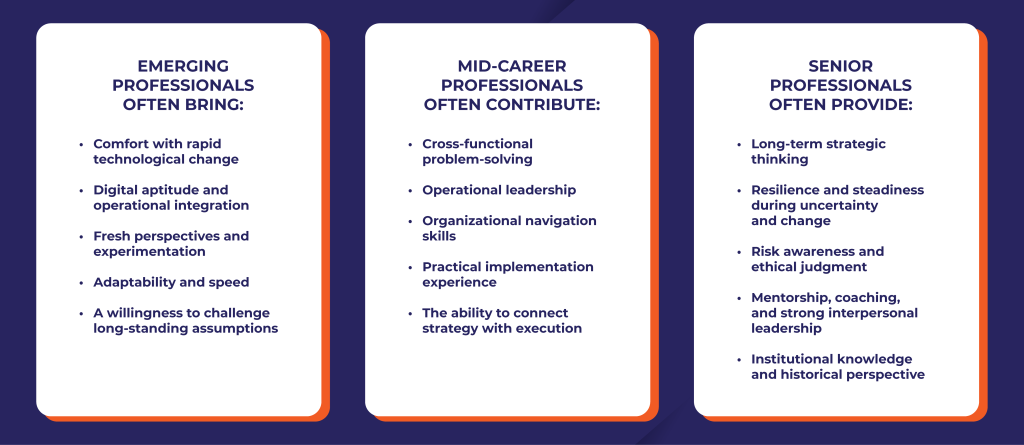
When these strengths work together, organizations gain something AI cannot replicate: creativity, innovation, and resilience. And this leads to real, quantifiable results. Companies with above-average diversity on their management teams, including age diversity, report innovation revenue that is 19% higher and profit margins that are 9% higher than companies with below-average diversity.
While AI can accelerate workflows, generate ideas, and increase operational efficiency, its true value to an organization’s long-term success emerges when it is shaped through the lens of these human elements.
This dynamic is especially important as organizations navigate questions AI cannot answer independently:
- What should be automated?
- What should remain deeply human?
- Where does efficiency improve quality?
- Where does efficiency erode trust?
- How do we preserve creativity and authenticity at scale?
Why the Best AI Workplaces Are the Most Human Ones
The organizations that succeed with AI will not be the ones that remove humanity from the equation. They will be the ones that amplify human strengths through technology. The ones that gain the speed and efficiency of AI while building a human culture of creativity, innovation, and resiliency to guide and shape the application of AI.
Intergenerational teams are essential to that future. They create the friction that sparks innovation, the perspective that prevents blind spots, and the culture that drives long-term success.
